
Interactive 3D Visualization: Presenting Complex Products in an Easy-to-Understand Way
Explaining Technical Products in an Easy-to-Understand Way
Machines and systems in industrial settings are often highly complex. Many functions are hidden inside, and it is difficult to explain their motion sequences using only photos or technical drawings.
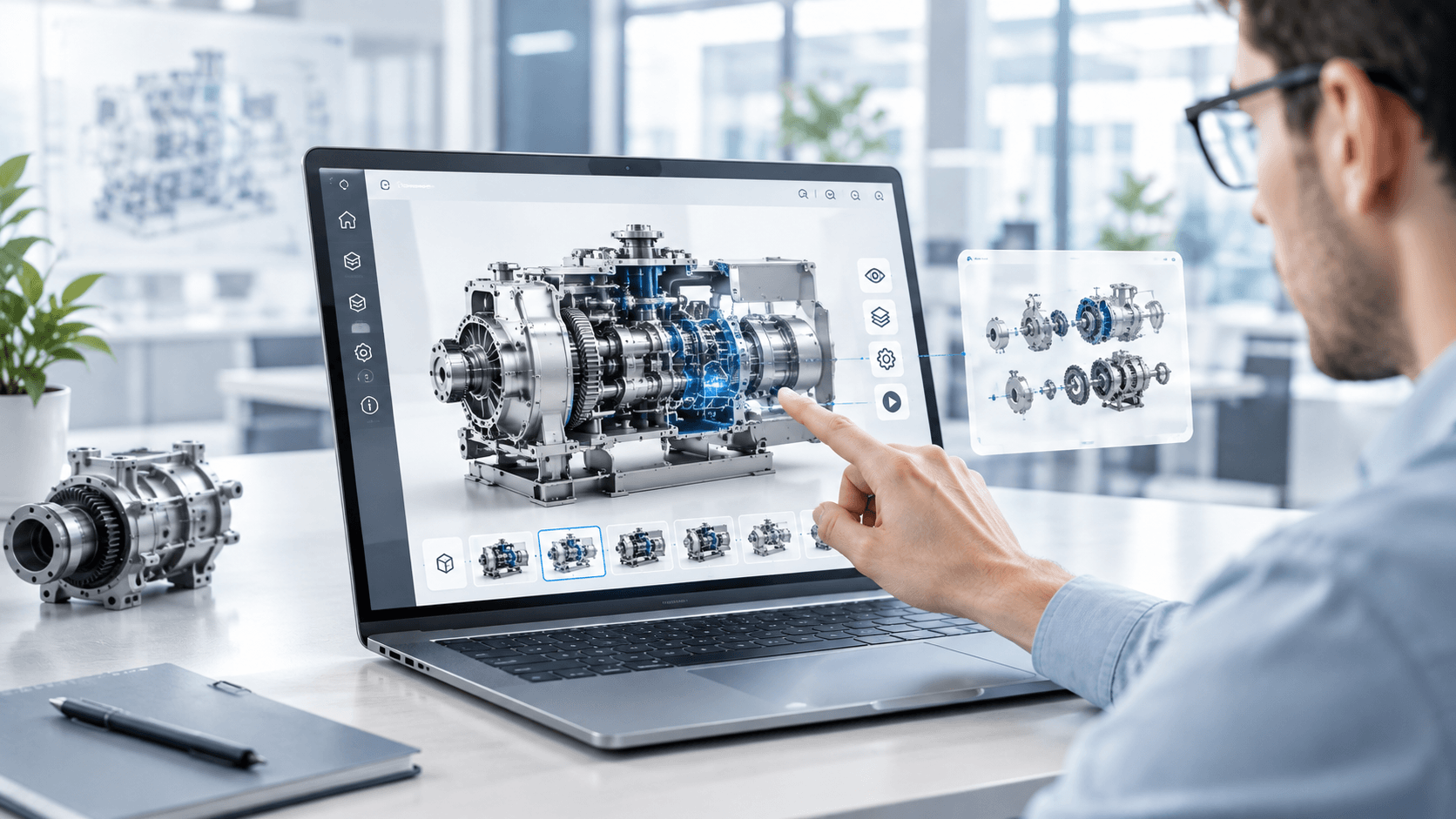
An interactive 3D visualization makes these relationships visible. Users can rotate and zoom in on a digital model, hide components, and explore individual functions step by step. This provides a clear understanding of the product—regardless of whether the actual machine is available on site.
What is an interactive 3D visualization?
An interactive 3D visualization combines a digital three-dimensional model with interactive features. It is often based on existing CAD data, which is processed for display on computers, tablets, touchscreens, or the web.
Typical features include:
- Rotating and zooming the 3D model
- Showing and hiding individual components
- Exploded views
- Displaying motion sequences
- Virtual cross-sectional views
- Displaying additional information with a single click
- Product configuration with different variants
- Animation of assembly, maintenance, or production processes
Visualization thus becomes not only a digital representation of a machine, but also a tool for communication and interaction.
Benefits for Sales and Marketing
Complex functions become easy to understand
Technical concepts can be explained directly using the model. Prospective customers don’t have to rely solely on drawings or lengthy texts to understand how things work. The ability to virtually remove housings or covers is particularly helpful. This reveals components that are difficult to access on a real machine.
Products can be presented regardless of location
An interactive visualization does not require the machine to be transported. It can be used at a trade show booth, during customer meetings, in digital presentations, or on the company’s website. This is particularly practical when dealing with large, heavy, or unfinished systems.
Variants can be compared visually
Many machines are customized. With an interactive 3D application, different configurations or assemblies can be compared directly with one another. This allows customers to see more quickly which solution meets their needs. Sales representatives can also present variants more clearly and conduct more targeted conversations.
The trade show experience becomes more immersive
At a trade show booth, numerous exhibitors compete for visitors’ attention. An interactive 3D model invites visitors to explore products on their own. Visitors can try out features and ask specific questions. This creates a natural entry point into the consultation and makes technical products more emotionally engaging.
Industrial Applications
Interactive 3D visualizations can be used in a variety of areas:
Sales:
Digital product models support sales pitches and help customers understand customized solutions.
Trade Shows and Events:
Touchscreens or interactive applications allow large systems to be presented in a compact space.
Marketing:
3D models can be integrated into websites, product presentations, brochures, or digital campaigns.
Training and Service:
Assembly procedures, maintenance steps, and the replacement of individual components can be explained visually.
Product Development:
Virtual models help present new concepts early on and gather feedback in a clear and understandable way.
Recruiting and Corporate Communications:
Technologies and production processes can be clearly communicated even to non-technical audiences.
From CAD Data to Interactive Applications
Many companies already have the necessary 3D data on hand. However, to create a compelling visualization, this data generally needs to be optimized and stylized.
This includes, among other things:
1. Selecting the relevant components and functions
2. Optimizing geometries for smooth rendering
3. Defining camera angles and interactions
4. Developing animations and information points
5. Adapting the visualization to the desired platform
6. Integrating the visualization into presentations, websites, or applications
Technical implementation alone is not the only crucial factor here. A good interactive visualization also requires clear user guidance. Users should intuitively understand which functions are available and what information they can access.
Real-World Example: Exploring a Facility Virtually
A mechanical engineering company wants to showcase a complex production line at an international trade show. Transporting the actual production line is not feasible. Instead, an interactive 3D model is being developed.
At the trade show booth, visitors can rotate the production line, select individual stations, and start the production process. Cross-sectional views reveal hidden components. Additional information explains how specific assemblies function.
After the trade show, the same application is used in field sales and during digital customer meetings. This makes the 3D model, once created, versatile and useful across marketing, sales, and service.
Conclusion: Present technology in a way that is easy to understand and flexible
Interactive 3D visualizations create a direct link between technical precision and clear communication. They help explain complex machines in a clear and accessible way, present products regardless of location, and illustrate individual variants.
For companies in the mechanical engineering sector, they are therefore a versatile tool for sales, marketing, training, and service. They are particularly effective when based on specific target audiences, usage scenarios, and communication goals.
Gosetti develops 3D visualizations and technical communication solutions that present industrial products in a clear, vivid, and compelling way.
