
Animated assembly instructions
Why moving instructions are the future of product communication - When images are no longer enough
We’re all familiar with traditional assembly instructions: small black-and-white drawings, cryptic arrows, and step-by-step explanations that often raise more questions than they answer. Especially with more complex products, this quickly leads to frustration, assembly errors, or unnecessary follow-up questions for support.
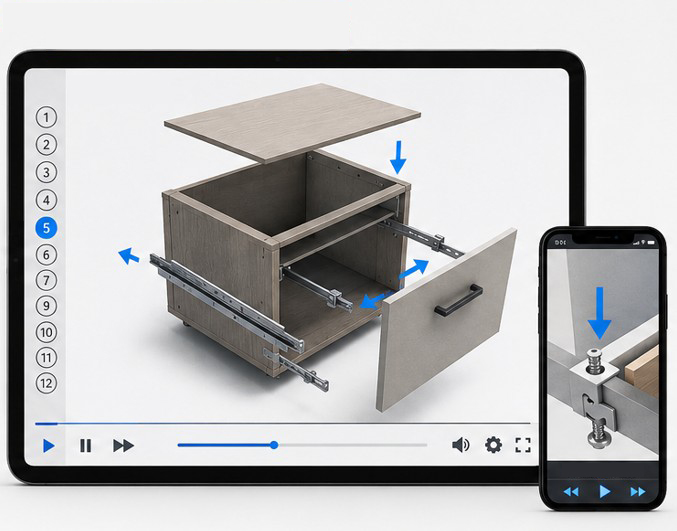
Animated assembly instructions solve exactly this problem. Instead of static images, they show the actual sequence of movements involved in assembly – in a way that is easy to understand, visual, and intuitive.
What is an animated assembly guide?
An animated assembly guide is a digital guide in which individual assembly steps are illustrated using animations or 3D movements. Users can see exactly:
- which part is used,
- how it must be aligned,
- in what order it is assembled,
- and what movements are required.
The visualization can be implemented as:
- a 2D animation,
- a 3D exploded view,
- an interactive web application,
- a video animation,
- or an AR/VR application.
Benefits of Animated Assembly Instructions
1. Comprehensibility increases significantly
The human brain processes animated content much faster than plain text. Users intuitively understand complex processes without having to read at length.
This offers a major advantage, especially when targeting international audiences: Animations work almost regardless of language.
2. Fewer Assembly Errors
Assembly errors often result from misunderstandings in the instructions. Animated processes clearly illustrate:
- direction,sequence,
- positioning,
- and movement sequences.
This significantly reduces error rates.
3. Support Costs Decrease
Companies often spend a lot of time answering questions about setup and assembly. A well-made animation answers many of these questions in advance.
This means:
- fewer hotline inquiries,
- fewer complaints,
- faster commissioning,
more satisfied customers.
4. Modern Brand Image
Digital and animated content comes across as innovative and professional. Companies use it to demonstrate:
- technical expertise,
- customer focus,
- and a capacity for innovation.
This can be a real competitive advantage, especially in e-commerce.
Animated assembly instructions are suitable for many industries:
Furniture Industry
- Cabinet and Kitchen Assembly
- Office Furniture
- Shelving Systems
Mechanical Engineering
- Maintenance Processes
- Spare Parts Assembly
- Technical Briefings
Industry & Manufacturing
- Training
- Safety Briefings
- Work Instructions
Consumer Electronics
- Smart Home Products
- Electronic Devices
- Accessory Assembly
Depending on the objective, different technologies are used:
Technology | Applications |
3D CAD Data | Basis for technical animations |
WebGL | Interactive 3D visualization in the browser |
Motion Design | Visual explanatory videos |
Augmented Reality | Assembly directly in the real world |
QR Codes | Quick access to digital instructions |
What’s particularly exciting is that many companies are using existing CAD data from the design department and converting it directly into animated content.
Why Animated Tutorials Are Becoming Increasingly Important
Customer expectations are changing. Today, people are used to:
- tutorials on YouTube,
- interactive apps,
- short explanatory videos,
- and visual communication.
In contrast, printed PDF manuals often seem outdated. Companies that want to create modern user experiences are therefore increasingly turning to digital and animated solutions.
Animated assembly instructions not only improve user-friendliness but also save companies time and money in the long run. They reduce errors, ease the burden on support teams, and ensure a modern product experience.
Anyone looking to explain complex products more simply can create real added value with animated instructions—both for customers and for internal processes.
The future of technical communication is visual, interactive, and dynamic.
We’re all familiar with traditional assembly instructions: small black-and-white drawings, cryptic arrows, and step-by-step explanations that often raise more questions than they answer. Especially with more complex products, this quickly leads to frustration, assembly errors, or unnecessary follow-up questions for support.
Animated assembly instructions solve exactly this problem. Instead of static images, they show the actual sequence of movements involved in assembly – in a way that is easy to understand, visual, and intuitive.
