
Blog
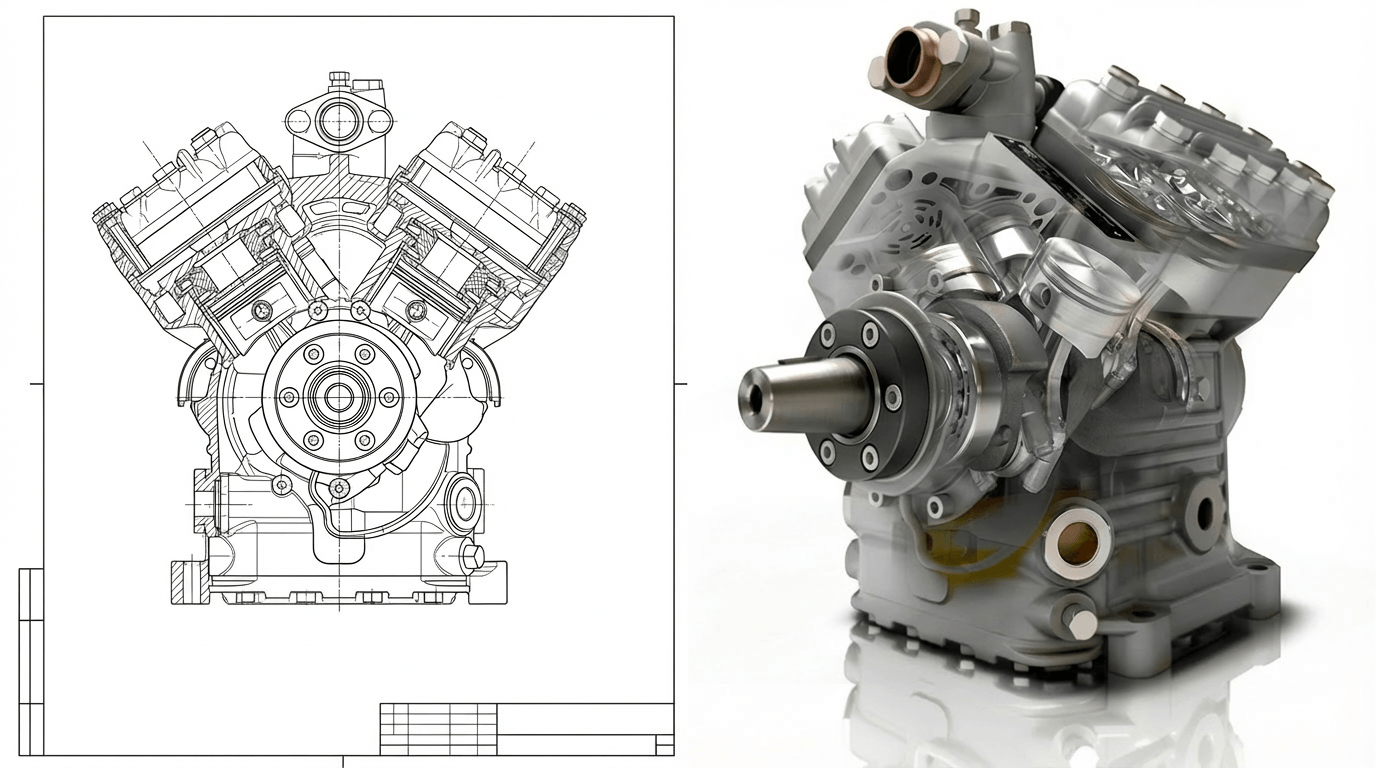
Why 3D visualization sells more in mechanical engineering than data sheets
Selling complex products is one of the biggest challenges in mechanical engineering. While technical data sheets provide all the necessary information, they rarely convince potential customers.
3D visualization in mechanical engineering offers a solution: it makes functions visible, reduces the need for lengthy explanations, and speeds up decision-making.
In this article, you’ll learn why visual clarity is more important in sales today than technical detail.
Learn why technical 3D visualization makes complex products easy to understand and significantly increases your sales opportunities in mechanical engineering.
Complexity Is Not a Selling Point
In the mechanical and plant engineering industry, there is often an unspoken principle:
The more complex the product, the better.
Technically, that may be true.
From a sales perspective, it’s a problem.
Because customers don’t buy complexity.
They buy understanding, certainty, and trust.
And this is exactly where the gap lies:
While engineers think in terms of functions, decision-makers need to quickly grasp the concrete benefits a solution offers.
Complexity impresses internally.
Clarity sells externally.
Data Sheets Explain - But Don’t Convince
The classic tool in technical sales is the data sheet.
It’s precise.
It’s comprehensive.
And often completely ineffective.
Why?
Because data sheets:
- Provide information, but don’t create a mental image
- Describe functions, but don’t provide context
- Show details, but don’t convey benefits
Especially when it comes to:
- capital goods
- products that require explanation
- international target audiences
text alone is not enough.
A decision-maker doesn’t want to have to interpret. They want to understand at a glance.
And that is exactly what data sheets fail to do.
3D Visualization as a Sales Tool
3D visualization bridges this gap.
It translates technical complexity into visual clarity.
Instead of:
- abstract descriptions
- hard-to-read drawings
- presentations that require extensive explanation
it creates an image that is immediately understandable.
A good 3D rendering or animation shows:
- how a product works
- how it is used
- what added value it delivers
And it does so in seconds.
This makes 3D visualization not just a “marketing extra,” but a central tool in sales.
Three Specific Benefits for Sales
Faster Decision-Making Processes
The more complex a product is, the longer the decision-making process takes.
The reason is rarely the technology itself – but rather a lack of understanding.
3D visualization drastically reduces this hurdle.
- Processes become visible
- Functions are intuitively understood
- Follow-up questions are reduced
The result:
shorter sales cycles and faster approvals
Better Understanding for Non-Technical Stakeholders
In many purchasing decisions, engineers aren’t the only ones at the table.
Instead:
- CEOs
- Purchasing managers
- Investors
These groups are involved in the decision-making process – but often don’t understand every detail.
3D visualization creates a common language here.
Complex content becomes:
- visually tangible
- understandable without specialized knowledge
- easier to discuss
This leads to:
greater confidence among decision-makers
Perceived Higher Value
How a product is presented influences how it is perceived.
A high-quality product with a weak presentation appears interchangeable.
A strong visual presentation, on the other hand:
- enhances perceived quality
- positions the company as innovative
- sets it apart from the competition
Especially in mechanical engineering, where products are often difficult to compare,
Case Study from Mechanical Engineering
A medium-sized plant manufacturer faced a typical challenge:
A complex custom machine was to be marketed internationally.
The explanation was provided via:
- technical drawings
- lengthy presentations
- detailed data sheets
The result:
- lengthy coordination processes
- numerous follow-up questions
- delayed decisions
The solution:
A combination of:
- photorealistic 3D visualization
- animated functional demonstrations
Within a short time, the sales dynamics changed:
- Customers understood the system faster
- Presentations became significantly more efficient
- Decision-making processes were noticeably shortened
One point in particular was decisive:
The machine no longer needed to be explained—it explained itself.
Conclusion: Anyone selling complex technology must think visually
Technical excellence is the foundation of every successful industrial product. But it is not enough.
Because: A product that is not understood will not be bought.
3D visualization creates:
- Clarity instead of complexity
- Understanding instead of explanation
- Trust instead of uncertainty
Companies that sell successfully today think not only in terms of functions – but in terms of images.
Because in the end, the bottom line is:
Technical excellence alone doesn’t sell.
Visual clarity does.
We offer free consultations and show you what’s possible with your products.